Hardware design
with evidence,
not assumptions.
OmeraCode turns hardware requirements into reviewable schematics, PCB artifacts, firmware traces and an auditable Evidence Pack — while engineers retain release authority.
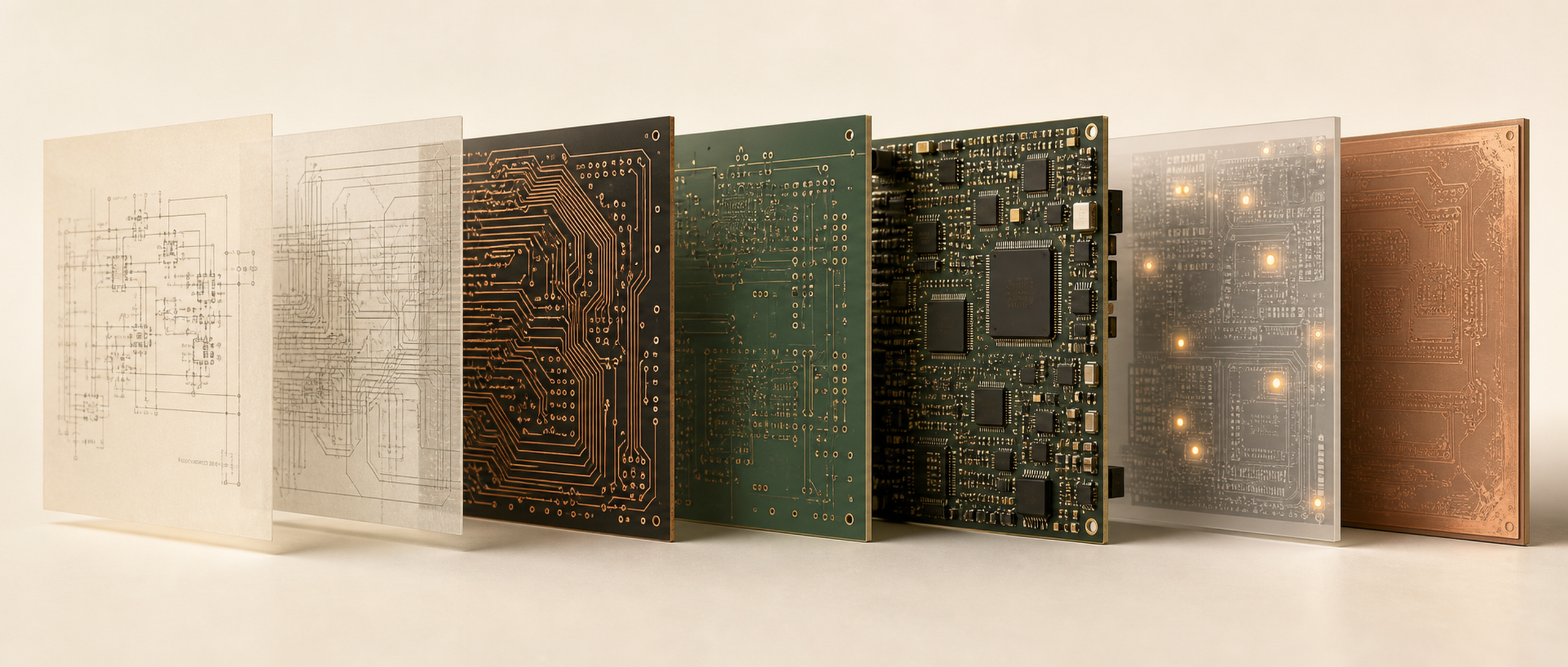
The Cost of Assumptions.
Most hardware delays are not caused by routing.
They are caused by assumptions that survive too long.
- — Requirements drift.
- — Component substitutions.
- — Calculation mistakes.
- — Verification gaps.
- — Review bottlenecks.
OmeraCode replaces assumptions with evidence.
The 18-Step Governed Hardware Pipeline
OmeraCode is built around an 18-step governed hardware pipeline — from requirements decomposition and schematic generation to layout validation, manufacturing gates, and Evidence Pack export.
Each board passes through structured checkpoints for electrical review, firmware alignment, DFM/DRC validation, manufacturing readiness, and evidence capture before release.
Project Dossiers
Active hardware programs managed and audited by OmeraCode. Each dossier represents a traceable program with live verification loops, requirements mapping, and signed evidence packages.
What "Verified" means.
- — Requirements are traceable.
- — Calculations are reviewable.
- — Design decisions are auditable.
- — Release artifacts are reproducible.
- — Human engineers retain sign-off authority.
- [+] Requirement Trace Matrix
- [+] Verification Log
- [+] Release Package
What OmeraCode is not.
We do not build chatbots that guess electrical layouts. We design systems that respect physical limits and human authority. Here are our architectural limits.
Not a replacement for engineering sign-off
AI does not have release authority. Engineers must explicitly confirm the final design packet.
Not a guarantee of manufacturing success
We verify parameters against constraints, but physical assembly remains subject to manufacturing variance.
Not a substitute for physical validation
OmeraCode verifies the design envelope. Hardware lab testing is still required for final validation.
Not a compliance certification authority
We enforce design rules, but official IPC/CE/FCC certification remains an external regulatory process.
Principles
Evidence is required. Assumptions are temporary.
Every design decision must be backed by a traceable, physical artifact.
A release state is earned, not declared.
Verification checks dictate readiness; a release cannot be willed into existence.
Authority remains human.
The co-design system proposes and verifies, but engineers retain final sign-off.
Traceability by default.
Every routing parameter maps back to an explicit IPC standard or design constraint.
Security by deployment boundary.
Proprietary intellectual property stays fully isolated within your local company perimeter.
A Design System for Verified Hardware
AI Structures & Orchestration
Analyzes raw requirement documents and extracts design variables. AI structures constraints, checks datasheet files, and outlines the required physical calculations.
Deterministic Engineering Solvers
Calculates track widths, impedances, signal loops, and power dissipation. Calculations use standard physical models (IPC-2152, Fourier conduction) with zero hallucination.
Independent Verification Gates
Audits the outputs from layers 1 and 2. Verifies constraints, maps schematic parameters to footprint boundaries, and triggers warnings for out-of-spec traces.
Human Engineering Sign-off
The final step in the chain. The system presents the verified artifacts alongside an auditable Evidence Pack. Release sign-off is restricted to the human authority.
Methodology: The 18-Step Co-Design Pipeline
The OmeraCode pipeline groups hardware design into six distinct phases. Hover or click each phase to review its input variables and verification checks.
Deconstruct requirements into structured engineering logic.
Ingests raw specifications, component parameters, and functional parameters. AI translates them into logical design assertions, verified against physical limits.
- — Textual requirements
- — Target board form factor
- — Power boundaries
- — JSON Requirement Schema
- — Assumptions log
- — Verification checklist
- • Requirement consistency check
- • Boundary integrity check
Evidence, not promises.
OmeraCode does not ask you to trust its designs. Every block, solver calculation, and layout check generates a detailed, machine-readable digital record.
The result is an Evidence Pack: an auditable directory containing parameters, calculations, DRC reports, and reviewer checksums that travels with the manufacturing release.
Recent Operational Records
Real-time build logs, safety gate blockages, and physical constraint recoveries compiled dynamically from the OmeraCode compiler pipeline.
Responsibility Allocation
System Responsibility
- — Check components against footprint bounds
- — Run calculations for impedance and heat conduction
- — Audit trace connections against rule specifications
- — Package design inputs, outputs, and checksums
- — Flag constraint violations and component conflicts
Engineer Responsibility
- — Input and clarify textual design parameters
- — Set structural bounds and layer constraints
- — Approve or override flagged clearance anomalies
- — Perform final review of electrical schematics
- — Sign and release the verified Evidence Pack
Designed for Critical Workflows
Power Electronics Review
Automates heat dissipation math and path clearance audits. Solvers calculate copper weight, loop paths, and power planes, compiling a verified thermal report.
Robotics & Motor Control
Co-designs board schematics with integrated feedback sensors. Compares pins against controller specifications to verify trace connections.
Private Local Deployments
For teams handling classified parameters. Runs entirely in local network environments with zero data leakage, validating blocks against local footprints.
Workspace isolation and air-gapped support.
We know hardware design parameters are company trade secrets. OmeraCode offers deployment setups that keep your database isolated.
Deploy the co-design pipeline inside your company network. No telemetry leaves the boundary, and data is never ingested to train public base models.
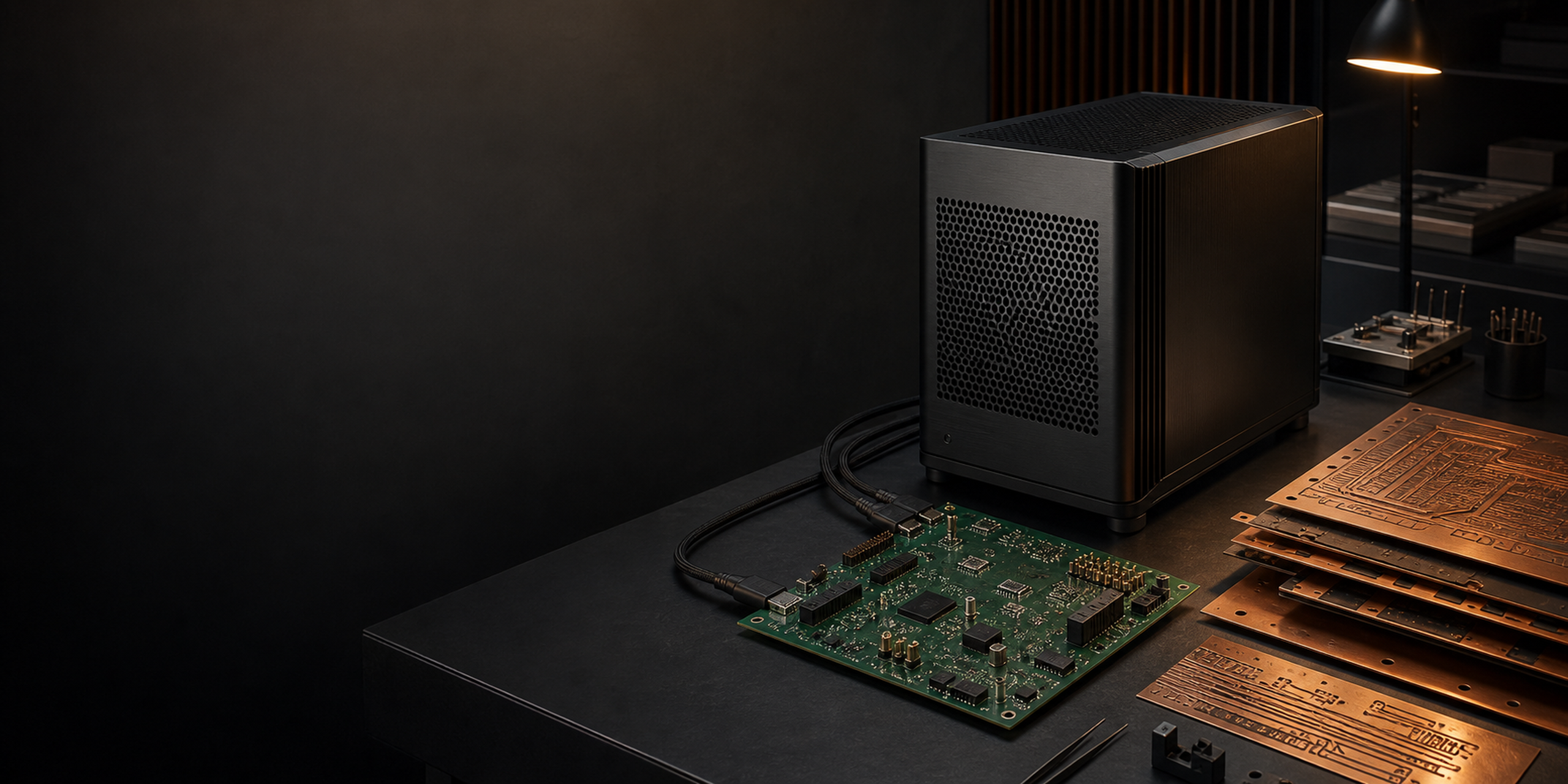
- SECURITY 01 Complete Workspace Isolation
Every engineering team operates inside a dedicated sandboxed workspace with custom footprint models.
- SECURITY 02 Air-Gapped Deployment Paths
Runs on local servers without internet access. Verification databases are stored on site.
- SECURITY 03 No Data Exposure
Your design inputs, schemas, and Evidence Packs are never shared, analyzed, or leaked.
Bring one difficult workflow. Measure what improves.
We are accepting a limited number of design partners for our 6-week diagnostic pilot.
We will work with your engineering team to model a high-risk circuit block, define its verification equations, and automate its review cycles.
For local prototyping, the form simulates submission in memory only. For preview/public beta, it interfaces with a server-side endpoint featuring rate limiting and secure database transfers.